Familiar Eyes in Unfamiliar Rooms: A 2026 Protocol for Accidental Overlaps
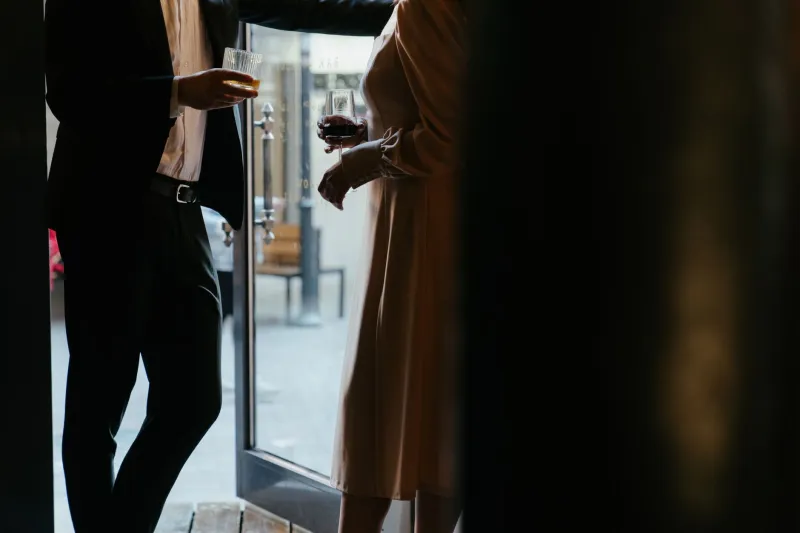
The arithmetic of adult nightlife is straightforward: the more often one visits discreet venues in a city of any size, the more likely it becomes that a familiar face will appear in an unfamiliar room. A colleague from the office, a neighbor from the building, a friend from a dinner party—none of them are supposed to be there, and neither are you. In 2026, the mature response is neither panic nor performance. It is a pre-arranged protocol, executed with the same calm courtesy one would bring to any other social overlap.
The First Principle: Mutual Discretion Is the Default
Assume the other person has as much at stake as you do. A chance sighting at a hotel bar, an adult lounge, or the hallway of a private apartment building is not an invitation to compare notes. It is a moment that calls for restraint. The goal is not to pretend nothing happened; it is to let nothing need explaining. Treat the familiar face as you would a stranger in a quiet room: acknowledge only if acknowledged, and then only minimally.
This principle matters most in smaller markets and in neighborhoods where professional and personal circles overlap. In a large city, the odds of recognition are lower per outing but higher over time. In either case, the correct posture is the same: low voice, steady hands, no visible alarm.
Before the Evening: A Two-Minute Briefing
The time to decide how to handle a familiar face is before the first drink arrives. A brief conversation with your companion—conducted privately, before arrival—prevents improvisation later. Agree on three things.
First, agree on a signal. A touch to the watch, a slight adjustment of a glass, or the phrase 'I think we should settle up soon' can communicate that recognition has occurred without naming the person. Second, agree that neither of you will approach or identify the familiar face unless that person initiates contact. Third, agree on departure logistics: who leaves first, whether you leave together, and where you will meet if you separate.
This briefing is not an overreaction. It is the same courtesy one extends by agreeing on a meeting point in a crowded restaurant. It simply accounts for a different kind of crowd.
The Geometry of Acknowledgment
Not every sighting requires the same response. Think in three tiers.
Tier one is no acknowledgment. Eye contact is brief or absent; the familiar face is across the room, facing away, or clearly occupied. In this case, do nothing. Continue your evening, but remain aware of exits and sightlines.
Tier two is silent acknowledgment. Eye contact is held for a beat, and the familiar face offers a nod or a small smile. Return exactly that: a single nod, no wave, no mouthing of names. A nod acknowledges the shared moment without inviting a conversation. It also signals that you understand the situation.
Tier three is direct greeting. The familiar face approaches or clearly gestures for you to come over. This is the least common outcome, but it requires the most preparation. Stand if appropriate, keep your voice low, and do not offer a seat unless your companion has signaled comfort. A brief greeting is enough. 'Good to see you. I am just heading out—can we catch up next week?' is a complete sentence and a complete exit.
Scripts for Deflection Without Drama
Scripts work best when they are short, plausible, and repeatable. Long explanations invite questions. The following lines are designed to close a door without slamming it.
To your companion, quietly: 'I have seen someone I know. I am going to finish this drink and call it an early night. Would you like to leave first, or shall I?' This gives your companion agency and avoids the appearance of a sudden flight.
To the familiar face, if approached: 'Good to see you. I am just wrapping up—can we catch up next week?' If asked what you are doing there, a simple 'Just wrapping up a long day' is sufficient. Avoid elaborate lies that require memory. The fewer details you offer, the fewer details there are to contradict.
If the familiar face asks about your companion, you are not obliged to provide a name or a relationship. 'This is a friend' is adequate. If your companion has agreed in advance to a brief introduction, keep it to first names only. If not, a polite smile and a return to the exit script is enough.
The Body-Language Exit
A graceful departure is mostly a matter of pace. Avoid sudden movements, hurried goodbyes, or a visible change in mood. Finish your drink if it is nearly finished; leave it if it is not. Settle the tab without discussion. Your companion may visit the restroom first, or you may, creating a natural stagger of five to ten minutes. Do not linger in the lobby, the elevator bank, or the valet line.
If the venue has a side exit or a second bar, use it. If you are in a private apartment building and the familiar face is a resident, wait for the elevator rather than sharing it. A brief 'I will take the next one' is unremarkable and effective.
Aftermath: Silence Is the Courtesy
The most important part of the protocol happens after you leave. Do not send a text, a direct message, or a 'small world' note. Do not ask mutual friends whether someone was at a particular venue. If the familiar face mentions the sighting later, match their level of discretion. Do not ask what they were doing there. Do not confirm details. Let the moment remain a moment.
In 2026, privacy is not only a matter of what is said; it is a matter of what is left unsaid. The familiar face in the unfamiliar room is not a problem to be solved. It is a social fact to be handled with the same courtesy that governs every other discreet engagement: low voice, steady hands, and a clean exit.