The Threshold and the Hallway: A Room-by-Room Standard for Apartment Visits in 2026
Apartment visits occupy a distinct place in discreet adult nightlife. A hotel has a lobby, a front desk, and a set of public protocols that most guests understand. A residential building has none of that buffer. It has a buzzer, a stairwell, a shared hallway, and neighbors who notice patterns. The standard for a 2026 apartment visit is therefore not theatrical secrecy. It is ordinary consideration applied with unusual care.
At Escort Lounge, the editorial view is straightforward: discretion in a residential setting is measured by what a visitor does not disturb. The goal is not to move through a building like a character in a spy film. The goal is to arrive, conduct the visit, and leave without adding noise, confusion, or unnecessary trace to someone else’s home.
Before the Address: Parking and Arrival Windows
Parking is the first test of residential discretion. In many US cities, the difference between a courteous arrival and a conspicuous one is a single sign. Read permit zones, hydrant markings, driveway clearances, loading restrictions, and street-cleaning notices before leaving the vehicle. Do not use a resident space because it appears empty. Do not block a driveway, alley, or fire lane. A delivery truck forced to stop in the street draws more attention than any guest intends.
Arrival timing matters as much as arrival location. A visitor who arrives twenty minutes early and idles at the curb creates a small but visible event. A visitor who arrives within the agreed window and follows the host’s instructions creates none. If a ride-share is used, choose a drop-off point that does not require the driver to wait in front of the building. Keep the vehicle quiet, keep the engine off where possible, and avoid repeated circling of the block.
The Buzzer: Timing, Name, and Voice
The buzzer is a boundary device, not a doorbell to be leaned upon. Press once and wait. If there is no response, allow a reasonable interval before trying again. Do not hold the button, do not press multiple times in quick succession, and do not attract the attention of every unit in the building. Follow the host’s instruction on what name or initials to use. If no instruction was given, keep the announcement brief and neutral.
In buildings with a doorman or front desk, follow the guest policy rather than inventing one. Do not claim to be maintenance, delivery staff, or a relative. If asked, identify yourself as a guest of the resident and provide the information the host has authorized. Wait in the designated area. Do not prop the lobby door, hold it open for strangers, or slip in behind another resident without being admitted. Security procedures exist for everyone in the building, including the person being visited.
Stairwells, Elevators, and Shared Hallways
A walk-up requires a steady pace and a quiet phone. Do not conduct a conversation on the stairs, play audio through a speaker, or linger on a landing. If another resident passes, a brief neutral greeting is sufficient. Detailed explanations are not required, and they are usually more conspicuous than silence.
In an elevator, allow residents to enter and exit first. Stand aside, keep the conversation minimal, and do not press extra floors to obscure a destination. That kind of maneuver is precisely the cloak-and-dagger behavior that draws attention without improving privacy. Use the correct floor. If a neighbor shares the elevator, keep the exchange courteous and general. A closed bag and a calm demeanor are better than a rehearsed story.
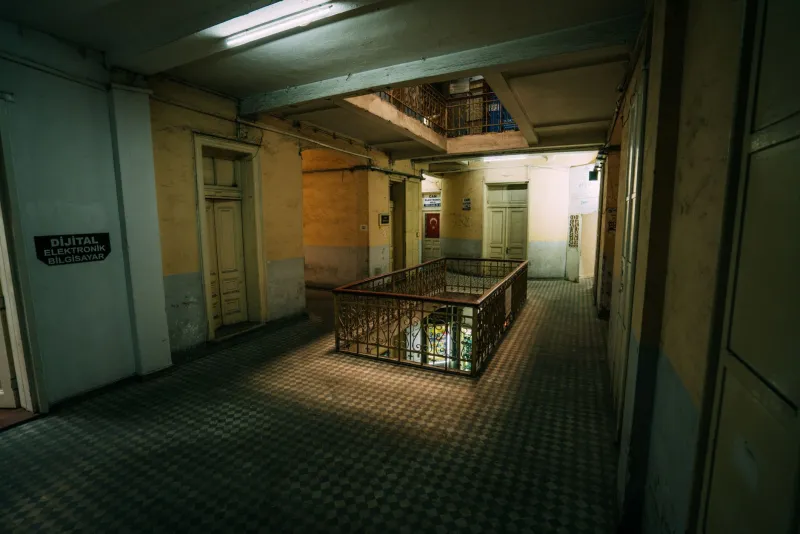
Shared hallways require similar restraint. Know the door number before entering the corridor. Do not scan several doors as though verifying an address. Do not knock loudly enough to carry into adjacent units. Keep voices low without turning the moment into a whispered performance. The most discreet guest is usually the one who looks as though he or she belongs there and has no reason to be noticed.
The Doorway and the First Minute
Wait to be admitted. Do not stand in an open threshold holding a conversation that can be heard down the hall. If the host’s household custom involves removing shoes, follow it without commentary. Let the host close the door. Confirm the agreed boundaries and consent inside the apartment, not in the corridor. A quiet, direct conversation at the start prevents confusion later and is more respectful than assuming that a residential setting makes details optional.
Inside: Sound, Light, and Shared Walls
Shared walls change the etiquette of an apartment visit. Voices carry. So do cabinet doors, furniture moved across hard floors, televisions turned up to mask sound, and phones left on ringers. Keep audio at a moderate level. Do not use music or television as a substitute for consideration. If the host has house rules about smoking, balcony access, or common-area use, follow them. Do not rearrange the apartment or open windows onto a shared courtyard without asking.
A visitor should also avoid leaving visible trace in common areas. Keep personal items together. Do not discard distinctive packaging in a hallway bin. Do not leave a bag, jacket, or beverage container in a stairwell or lobby. If something is brought into the apartment, take it out or dispose of it as the host directs. The point is not to erase every sign of a visit. It is to avoid leaving evidence in spaces shared with neighbors.
Departure: The Quiet Exit
A graceful departure is part of the visit, not an afterthought. Leave at the agreed time. Say goodbye inside rather than in the doorway or hallway. Check for belongings before stepping out. Use the same exit route and do not linger at the elevator, in the lobby, or at the curb. If a ride-share is waiting, follow the building’s rules about pickup areas. Do not let a car idle directly in front of the entrance for an extended period.
Late departures call for extra quiet: a gentle door close, a measured walk, no conversation in the stairwell. A single visit may seem minor, but neighbors remember repeated late-night patterns. Discretion is cumulative.
Neighbor Awareness Without Paranoia
Neighbors are not the audience for an apartment visit, but they are part of the building’s ordinary life. The aim is not to become invisible. The aim is to be unremarkable. Do not mislead building staff, bribe a doorman, or use fire stairs unless directed. If a neighbor asks a casual question, a brief and courteous answer is enough. Questions about the host’s schedule or personal life should be referred back to the host.
Residential discretion in 2026 is ultimately a standard of consent and courtesy. The visitor who respects parking rules, buzzer timing, shared walls, and the quiet exit protects the host, the neighbors, and the professional nature of the engagement. No elaborate choreography is required. Small choices, made consistently, are the whole method.